Authority Asset
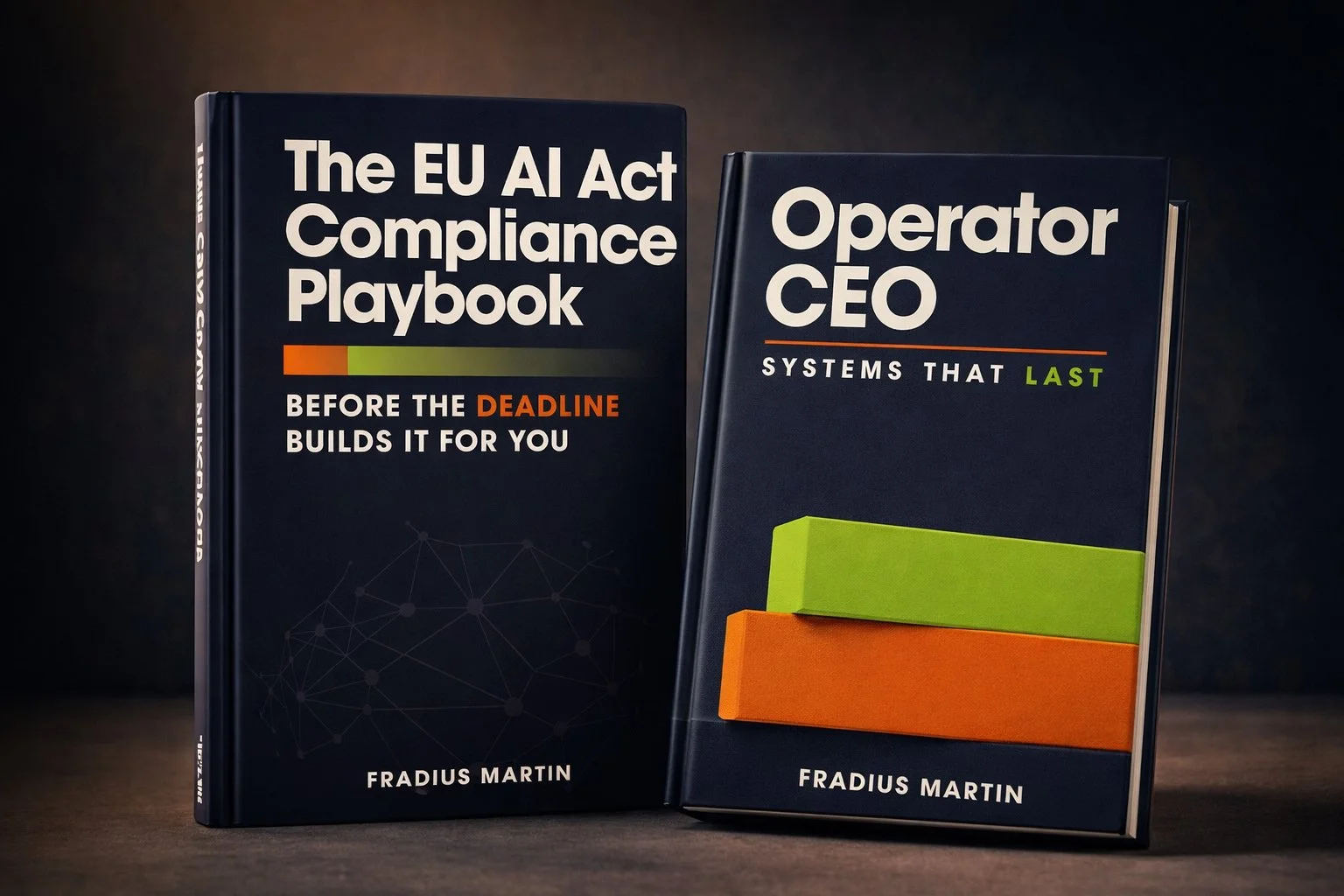
The EU AI Act Compliance Playbook
The Operator’s Guide to Building Audit-Ready AI Governance Before the Deadline Builds It for You
Most teams do not need another legal summary. They need a governed path from uncertainty to evidence.
Why this book exists
The problem is not awareness alone. It is governed implementation.
Too many organizations are still treating the EU AI Act as something to interpret later. That is the wrong posture.
This regulation is already phasing into force, and the timelines are no longer uniform. Prohibitions and AI literacy duties have already applied, and GPAI obligations and governance infrastructure are already live. Article 50 transparency obligations remain scheduled for 2 August 2026. Following the Digital Omnibus provisional agreement of May 2026, the main Annex III high-risk rules now apply from 2 December 2027, and high-risk obligations embedded in products (Annex I) from 2 August 2028.
The problem is not simply understanding the law. The problem is making compliance operational before regulators, enterprise buyers, procurement teams, or national authorities ask your organization to produce evidence it does not yet have.
Core thesis
Compliance becomes durable only when governance enters the operating system.
The central argument of this playbook is simple: organizations will not meet the EU AI Act through commentary alone. They will meet it by building a usable operating model.
This book is not written as legal theatre. It is written as an operator’s guide for building audit-ready AI governance under real conditions.
What the book covers
What leaders will work through inside the playbook
This playbook is structured to help organizations move from confusion to governed execution.
- the phased compliance timeline and what applies when
- the risk classification sprint
- the FLT governance architecture
- risk management that survives audit
- data governance and bias controls
- documentation that does not destroy the team
- human oversight under Article 14
- transparency and content marking
- conformity assessment, CE marking, and market placement
- a 90-day implementation pathway
The difference in approach
This is written as an operator's guide, not a policy digest.
What distinguishes this book is not just subject matter. It is perspective.
The book frames compliance as an operating-system build rather than a legal reading exercise. It introduces FLT — Facts, Logic, and Tone — as the governance architecture used to organize the work: Facts as the evidence layer, Logic as the control layer, and Tone as the trust layer.
That gives the book a different quality from most AI Act commentary. It is not asking leaders to admire the regulation. It is asking them to build the internal architecture that will survive scrutiny.
Who this book is for
Who this book is for
- CTOs and engineering leaders
- CISOs and DPOs
- Chief AI Officers, Heads of Data, and ML platform leaders
- Compliance officers
- CEOs and founders selling AI-enabled products into Europe
- Technology leaders outside the EU whose systems still touch the EU market through customers, users, or outputs
Why this matters now
Delay makes the operating burden heavier.
This is not just about avoiding penalties. It is also about operational continuity, market access, procurement readiness, enterprise trust, and whether your organization can demonstrate governed AI under pressure.
Organizations that begin now gain options. Organizations that delay create compliance debt, evidence gaps, and avoidable pressure. Build before the deadline forces you to.
How this fits the Fradys pathway
Read the book, then move into governed action.
The natural implementation path from this book is the EU AI Act Readiness Toolkit for practical working templates, then the AI Act Readiness Sprint for a structured two-week compliance roadmap, followed by governance capability building through Fradys Academy where appropriate.
Companion volume
Part of a wider operator-grade leadership library
This playbook has a companion volume: Operator CEO: Systems That Last.
Where The EU AI Act Compliance Playbook focuses on the regulatory implementation of governed AI under the EU AI Act, Operator CEO addresses the broader executive discipline of building governed, production-grade systems that survive growth, handover, and operational pressure.
FAQ
Frequently Asked Questions
Is this only for legal teams?
No. The EU AI Act Compliance Playbook by Fradius Martin is written for leaders who must make AI governance operational across compliance, technology, and delivery functions. It is designed as an operator guide, not a legal reference.
Does this replace legal advice?
No. The EU AI Act Compliance Playbook is an implementation guide that helps teams become more organized, evidence-ready, and operationally disciplined alongside formal legal review where needed. It uses the FLT Protocol (Facts, Logic, Tone) governance architecture from Fradys Technologies.
What is the next step after the book?
The next practical step is the Fradys Technologies AI Act Readiness Sprint ($22,000, two weeks) for teams that want a structured applicability assessment, controls review, gap analysis, and 90-day action plan. Article 50 transparency obligations apply from 2 August 2026, while the main high-risk obligations apply later (Annex III from 2 December 2027, Annex I from 2 August 2028) under the Digital Omnibus provisional agreement of May 2026.
Final close
Build governance before the deadline builds it for you.
The EU AI Act is not asking whether your organization is interested in governance. It is asking whether your systems can be explained, classified, documented, overseen, tested, and defended.
The EU AI Act Compliance Playbook was written for leaders who need to answer that question with evidence, not optimism.